
If you manufacture shampoo, dishwashing liquid, hand wash, or liquid detergent, chances are SLES is already on your raw material list — or it should be. Sodium Lauryl Ether Sulfate is one of the most widely used surfactants in the personal care and home care industry, prized for its foaming power, cleansing efficiency, and cost-effectiveness.
This guide breaks down what SLES actually is, how it works, where it’s used, the grades available in the market, and what to look for when sourcing it in bulk
What Is SLES?
SLES, short for Sodium Lauryl Ether Sulfate (also called Sodium Laureth Sulfate), is an anionic surfactant derived from lauryl alcohol, which is typically sourced from coconut or palm kernel oil. The alcohol is ethoxylated and then sulfated to produce a compound that is water-soluble, foams readily, and cleans effectively by lowering the surface tension between oil and water.
Chemically, SLES belongs to the same family as SLS (Sodium Lauryl Sulfate), but the added ethoxylation step makes SLES milder on skin and eyes while retaining strong foaming and cleansing performance. This balance of performance and mildness is why SLES has become the default surfactant choice across so many formulations.
Key identifiers:
- INCI Name: Sodium Laureth Sulfate
- Common CAS Numbers: 9004-82-4 (general), with specific ethoxylation grades carrying their own CAS numbers
- Appearance: Clear to slightly yellow viscous liquid or paste, depending on concentration
- Solubility: Fully water-soluble
- Typical Active Content: Supplied as 70% or 28% active matter
How SLES Works
SLES is an amphiphilic molecule — one end of the molecule is attracted to water, and the other is attracted to oil and grease. When mixed into a formulation, SLES molecules surround dirt, oil, and sebum particles, lifting them away from skin, hair, or surfaces and suspending them in water so they can be rinsed away. This same mechanism is what generates the dense, stable foam that consumers associate with a “clean” product.
Where SLES Is Used
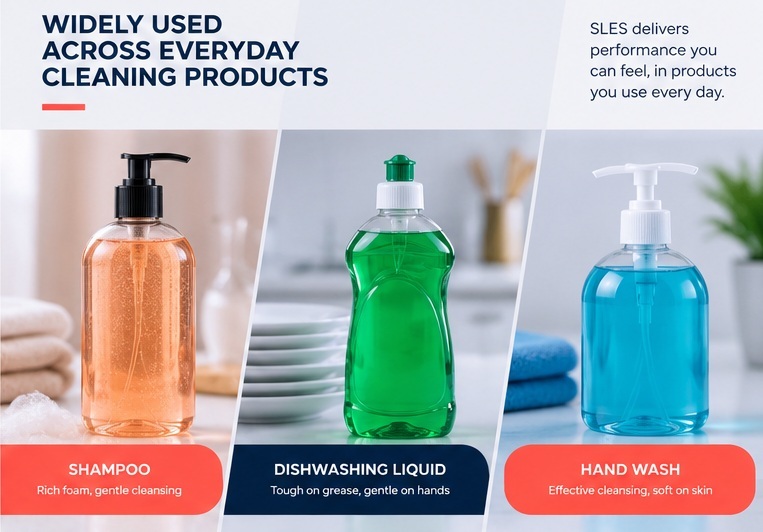
SLES shows up across a wide range of home care and personal care formulations, including:
- Shampoos and conditioners — as the primary cleansing surfactant
- Body washes and shower gels — for lather and cleansing
- Facial cleansers — typically at lower concentrations for milder formulations
- Liquid hand wash and hand soap
- Dishwashing liquid — for grease-cutting and foam
- Liquid laundry detergent — often paired with LABSA and AOS
- Toothpaste — in small quantities, as a foaming agent
- Industrial and institutional cleaners
Because it performs well across both personal care and home care applications, SLES is often one of the first ingredients a new formulator sources when developing a cleansing product.
SLES Grades and Concentrations
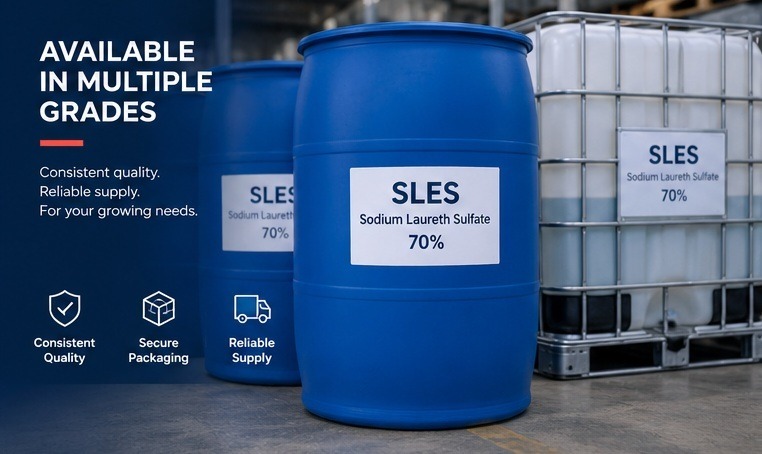
SLES is typically supplied in two main active concentrations:
| Grade | Active Matter | Common Form | Typical Use |
|---|---|---|---|
| SLES 70% | 68–72% | Viscous paste/gel | Diluted on-site by manufacturers for cost efficiency in bulk formulations |
| SLES 28% | 26–30% | Pourable liquid | Ready-to-use concentration for smaller batch production |
Ethoxylation level (EO number) also varies — 2EO and 3EO are the most common in the market. A higher EO number generally increases mildness and clarity but can slightly reduce foam density, so the right choice depends on your target formulation.
What to Check Before You Buy SLES in Bulk
Not all SLES is created equal, and quality inconsistency between batches can quietly wreck a production run. When sourcing SLES for bulk manufacturing, it’s worth confirming the following with your supplier:
- Active matter percentage — verify it matches the certificate of analysis (COA) for every batch
- 1,4-Dioxane levels — a processing byproduct that should be tightly controlled and disclosed
- pH stability range — typically 5.0–8.5, important for compatibility with other actives
- Unsulfated matter and sodium sulfate content — impurities that affect performance and clarity
- Consistency across batches — inconsistent viscosity or color can signal supply chain quality issues
- Packaging and storage conditions — SLES should be stored in a cool, dry place away from direct sunlight to preserve stability
Working with a supplier that provides a COA with every shipment, and who sources from certified manufacturers, removes most of the guesswork from formulation and batch planning.
SLES vs. SLS: What’s the Difference?
This is one of the most common questions formulators ask. SLS (Sodium Lauryl Sulfate) is produced without the ethoxylation step, making it a stronger degreaser but also more likely to cause skin and eye irritation at higher concentrations. SLES, because of ethoxylation, is milder and better suited to leave-on and rinse-off personal care products, while SLS is often reserved for heavy-duty cleaning applications or used in smaller proportions alongside milder co-surfactants.
For manufacturers producing both personal care and home care lines, sourcing both SLES and SLS from the same supplier simplifies procurement and ensures formulation consistency across product ranges — explore our full range of home care raw materials, including SLES, SLS, acid slurry, and AOS.
For manufacturers producing both personal care and home care lines, sourcing both SLES and SLS from the same supplier simplifies procurement and ensures formulation consistency across product ranges.
Sourcing SLES for Your Production Line
Whether you’re scaling up a shampoo line or reformulating a dishwashing liquid, having a dependable SLES supply chain matters as much as the formulation itself. Delays, inconsistent active content, or undisclosed impurities can stall production and compromise finished product quality.
[EXTERNAL LINK: industry data or regulatory guidance on surfactant safety thresholds, e.g. from a cosmetic ingredient review body]
Truform Chemicals supplies bulk SLES, SLS, and other home care raw materials sourced from globally certified manufacturers, with transparent pricing, batch documentation, and reliable delivery across India. If SLES is part of your formulation, our team can help you identify the right grade and concentration for your specific application.
FAQ
Is SLES safe to use in personal care products?
Yes, when formulated within regulatory guidelines and industry-recommended concentrations, SLES is considered safe for use in rinse-off and leave-on personal care products. Reputable suppliers keep byproducts like 1,4-dioxane within controlled limits.
What’s the difference between SLES 70% and SLES 28%?
The number refers to active matter content. SLES 70% is a concentrated paste that manufacturers typically dilute during production, while SLES 28% is a ready-to-use liquid concentration, often preferred for smaller-scale or simpler production setups.
Can SLES be used in both shampoo and dishwashing liquid?
Yes. SLES’s foaming and cleansing properties make it suitable for both personal care and home care applications, though usage rates and supporting ingredients will differ significantly between the two.
How is SLES typically packaged for bulk purchase?
SLES is commonly supplied in HDPE drums (around 160–170 kg), IBC totes, or tank quantities for large-scale manufacturers, depending on order volume.
What should I ask a supplier before purchasing SLES?
Ask for a current Certificate of Analysis (COA), confirmation of active matter percentage, 1,4-dioxane levels, and batch-to-batch consistency data before committing to a bulk order.